
A Quick Chat with Matt Rai
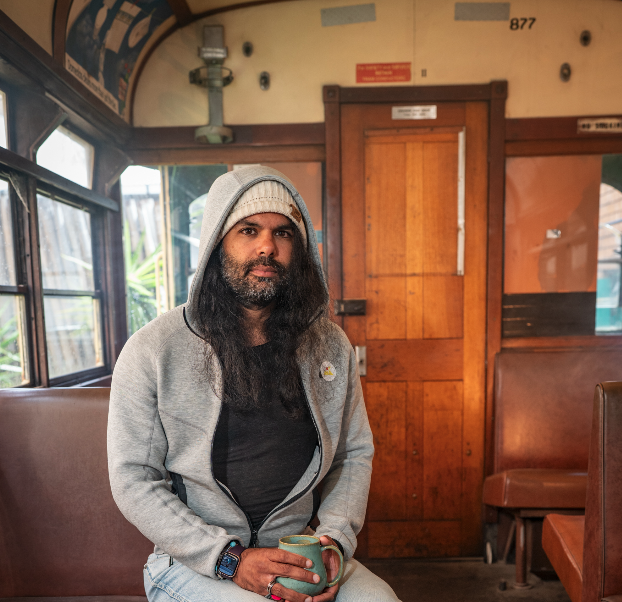
You have spoken about shifting away from traditional career paths toward more meaningful work. How does that pursuit of purpose show up in Silence As Bombs Fall Down?
I wrote Silence As Bombs Fall Down about 20 years ago, partly in response to 9/11. At the time, I was in the UK, stepping into a more traditional life, work, stability, building something secure.
But music never really left. It was always there in the background, quietly waiting.
Life took over. I wanted to be a dad, to build something stable, and I probably wasn’t brave enough back then to fully step into the music.
But the songs stayed. Releasing them now feels like finally giving those thoughts somewhere to live. Some of those ideas have been sitting quietly for years, and this EP is the first time they’ve had a voice.
There is a deliberate absence of frills in this EP, and even the recording process reflects that, capturing Bombs Fall Down live in an abandoned tram with just your voice and guitar. How important is environment to the honesty of what you are creating?
I used to play these songs with a full band, but without a big budget, I had to simplify.
That became a choice. I realised I trusted the songs enough to strip everything back.
I’ve always loved artists like Nick Drake and Jeff Buckley, where there’s nowhere to hide. Just the song and the voice. Environment played a big role in that.
Millie Piskopos understood the tone straight away and created something that felt aligned, not overworked. Recording with Brett Quirk was similar, his space was calm, welcoming, and easy to settle into. When you feel at ease, you stop performing and start being honest.
Founding Schools for Nepal and working as a life coach both centre around helping others find clarity. Do you see your music as part of that same thread?
On the surface, charity work, coaching, and music seem selfless. But they’re also deeply personal. Nepal showed me that small actions matter, and that helping others shapes who you become. We all have a darker side too, but recognising that gives you a choice.
The music sits alongside that. It’s something I needed to do, not for a career, but because it matters. Helping others find clarity and trying to live it yourself are really the same thing.
The EP is already reaching listeners across 39 plus countries. Does knowing your music is travelling globally change how you think about the intimacy of these songs?
It’s actually up over 50 countries now haha, feels surreal.
If anything, it’s given me confidence. People connecting with something so stripped back reassures me that keeping it simple was the right choice.
I think the title resonates too. There’s a shared sense of uncertainty in the world right now.
I don’t have answers, but I think people are connecting to the feeling of asking the same questions.
The live performance videos feel almost like an extension of the recordings, raw, unguarded, and immediate. What role does visual storytelling play in how you want people to connect with this project, especially with that dystopian, protest undercurrent?
I haven’t overthought the visuals. It’s been more about finding the right people.
Working with Millie was a big part of that. She understood the song and kept it grounded in Melbourne, which matters to me.
I just wanted it to feel as raw as the performances. No over-polishing, no hiding.
The goal was simple: let it feel real, and let people take from it what they need.
Looking ahead, do you see yourself continuing down this minimalist path, or are there other sonic or thematic directions you are quietly moving toward?
The EP’s only been out just over a month, so I’m still building around it.
I want to evolve the live performances, maybe add subtle textures, but keep it centred around the 12-string. I’m also thinking about extending the EP. There are a few more songs that belong in that same world. The direction won’t change, just the depth of it. Minimal, raw, and honest still feels like the right lane.