
A Quick Chat with Felsmann + Tiley
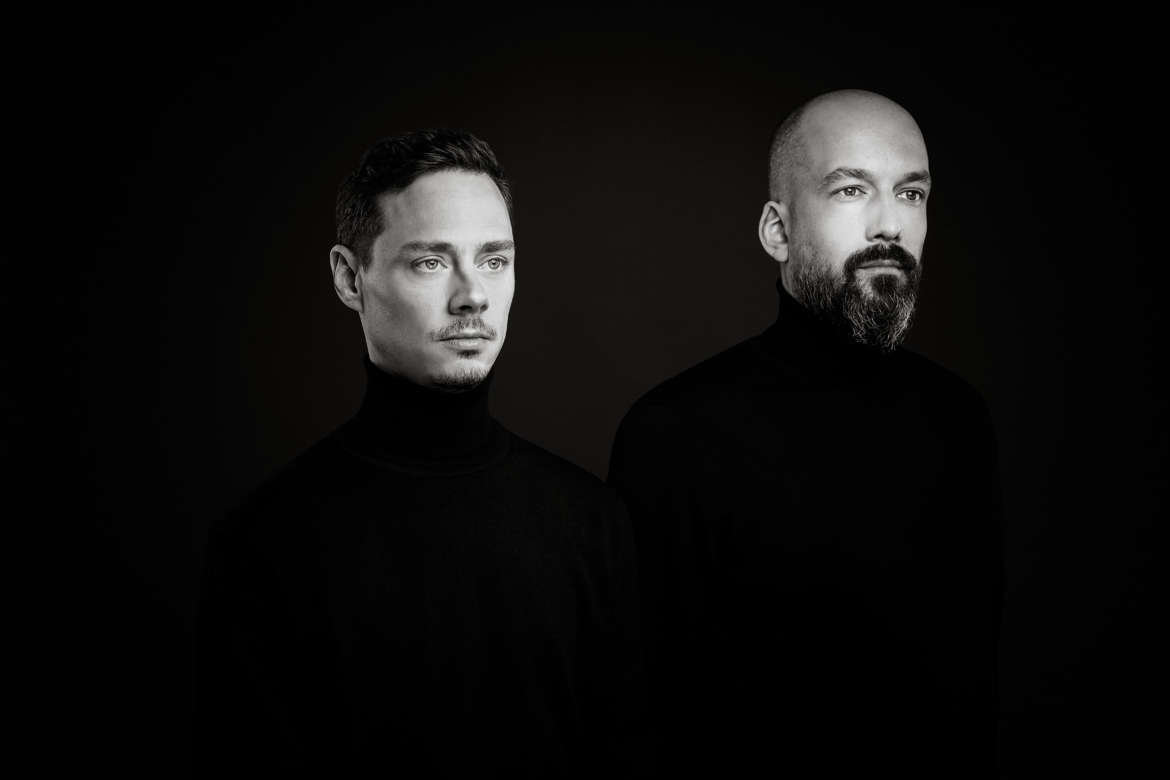
What are the origins of Felsmann + Tiley? How did you start creating together?
We started out in our teens making trance music and touring as DJs. What connected us early on was the combination of energy and melancholy, big synth riffs, emotional tension and a shared obsession with programming sounds. That DNA is still very present in our music today, just translated into a less club-focused form and expanded with neoclassical and film music elements. Back then we carried our favourite gear across town in sports bags, today most of the collaboration happens online or when we meet somewhere around the globe. Despite the shift in our sound, the process and the emotional core has remained the same.
Protomensch is built around the idea of the “proto-human.” What does that term mean to you personally, and why did it feel like the right lens for this album?
For us, the Protomensch describes the human as an unfinished experiment. We are hyper-intelligent, technologically advanced and emotionally complex, yet still deeply irrational, fragile and often destructive. We build rockets, cure diseases and generate unimaginable knowledge, while repeating the same patterns of violence, denial and self-sabotage.
It felt like the right lens for the album because it offers strong visual and emotional cues to explore, adding another layer to the music beyond sound alone. The concept also became a powerful point of connection with collaborators, it sparked ideas quickly and gave everyone a shared framework to respond to creatively.
The record explores big themes like technology, faith, power and media. Was there a particular moment or realisation that made you want to dig into those ideas now?
The concept existed long before the album, more as a broad observation than something tied to a specific moment in time. Living through 2025 and 2026, however, it increasingly felt like we had started writing a soundtrack for the present years ago. The rise of AI, ongoing wars, major political shifts and the increasing frequency of natural disasters all seemed to echo the themes we had already been exploring.
“Always You” features Woodes, who you’ve also collaborated with through 4000 Studios. What drew you to her voice and perspective for the emotional core of the album?
We love her voice, her project, her songwriting and we’re good friends. A large part of the album explores darker emotional territory, and “Always You” represents a hopeful, deeply human counterpoint. Her gentle, soft voice and the way she delivers her performances felt exactly right for that moment on the record. It brings warmth and reassurance without feeling naïve.
Collaboration is a big part of your creative life, both on this album and through 4000 Studios. What do you look for in collaborators, and how do shared values influence the music that comes out the other side?
There are a few things we really care about: We need to genuinely love their music and their voice has to bring something human and new into our synth-driven world. They also need to intuitively understand our music, so we can work without overexplaining ideas. And on a human level, we need to get along. When those things align, the music writes itself.
4000 Studios has become a real creative hub. How does mentoring and working closely with other artists feed back into your own practice as a songwriter and producer?
It’s a place where artists from very different musical backgrounds meet. Many of the moments where we thought, “we need to work with this person,” came from simple listening sessions at the studio where we were completely blown away by someone’s work. Australian music, in particular, has a lot of edge, people care deeply about making something special rather than something that fits in. That energy is a constant reminder of why we make music in the first place. In that sense, 4000 Studios indeed became a nurturing ground for Protomensch.
With Protomensch, what do you hope listeners sit with after the final track, emotionally or philosophically?
With the accompanying Manifesto, we’re inviting listeners into a space of existential inquiry. But music should always remain open-ended. It can mean very different things to different people and that’s its strength. Music often communicates on a level words can’t reach, while words can set a scene and spark imagery that changes how we listen. That interplay is fascinating to us, and we hope listeners carry something personal with them rather than a fixed conclusion.
The live show and visual elements bring Protomensch into a fully immersive space. How important is it for you that audiences experience this project as more than just a collection of songs?
It’s very important to us. A lot of music today is designed for quick consumption, which is completely valid. We wanted to create something that asks for a bit more attention and presence, something that rewards multiple listens and invites people to explore the wider world around it, whether that’s through our visuals, socials, website or music videos.
The immersive setup isn’t just a beautiful way to experience the music, it fundamentally shifts how the listener relates to it emotionally. The live show allows us to turn emotional arcs into something shared and physical, turning the project into an experience rather than “just” an album.
Are there any plans to tour the show more broadly in 2026?
Absolutely. We’re currently exploring options to bring the show to more cities in 2026. The focus is on finding the right spaces and contexts rather than touring for its own sake. We’ll be announcing more dates soon!